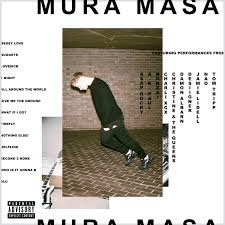
Mura Masa – Mura Masa

Your first listen of Mura Masa’s self titled album will not be the first time that you have heard most of Alex Crossan’s debut release. Album highlight “Love$ick” (featuring A$AP Rocky) is sandwiched between two other early releases in “Nuggets” and “1 Night”, featuring Bonzai and Charli XCX, respectively, which are then followed by the Desiigner accompanied “All Around The World”.

You get the theme here. Like other debut releases from UK producers such as Disclosure and Jamie XX, Mura Masa is largely comprised of Crossan’s distinct go-to production style of a mixture of Tropical House and Hip-Hop, which he changes up ever so slightly to allow his collaborators to flourish. The producer has been making music as Mura Masa since 2014 and “Love$ick”, first released in 2016, in fact started life as instrumental “Lovesick,” released in 2015. Having listened to both, it is clear that A$AP Rocky turns a good song into a great one. The same can be said for the even more radio friendly “1 Night” with Charli XCX; all collaborations on the release are well executed.

One of the album’s less familiar collaborators should, however, excite fans the most – Dublin artist Bonzai is signed to Crossan’s own label Anchor Point Records, which suggests Crossan has his sights set on a career with an element of longevity, or at least alternative paths to success.

Once you get through the songs that have been showing up in your streaming site playlists for months, Mura Masa reveals that there may be slightly more to Crossan’s production than we are giving him credit for. “Helpline” abandons any Tropical House elements in its production, with a chorus and accompanying synth line delivered by Tom Tripp that Jai Paul would be proud of. Interestingly, A.K. Paul (older brother of Jai) makes an appearance on “Who Is It Gonna B”, and the even more morose “Blu” (featuring Damon Albarn), accompanied by harps and understated warbling base, brings the album to a bittersweet close.

Although one could fault a release strategy that gave away most of the album’s surprises long in advance, the strength of Mura Masa’s singles and the range of collaborators on the project mean it will go down as a summer 2017 highlight. Far from being the name on music fans’ lips for only 2017, Alex Crossan – releasing music as Mura Masa or as head of his own label – could be around for a while, making everyone excited for what lies ahead. In doing so, Crossan has achieved what any artist releasing their debut album sets out to do.

78
The Mid-track Changeup

FrandandAndyC

When listening to Anderson .Paak’s new album, we are exposed to numerous changes in musical influence, production, flow and subject matter; not just from song to song, but even within a single track. Has the concept of the “track” therefore become outdated and, if so, should we care?

It’s creeping into most big releases in the Hip-hop and R&B world: the change-up. Mid-song, or indeed mid-verse, listeners are taken in a completely different musical direction by artists. Its use is widespread on Anderson .Paak’s “Malibu”, and some, including a dear friend of mine, suggest this shows a lack of creativity in that .Paak is incapable of, or seemingly ambivalent towards, building a track towards what feels like an organic conclusion. But is this line of argument predicated on an outdated line of thinking about the concept of a “track”?

In exploring the reasons for changing up flows on a song in the Hip-hop world, historically at least, the argument was simple: a rapper/MC’s ultimate aim is trying to prove that he is better than his peers. What better way to do that, than showing off as many skills as possible? Although the song is slightly tongue in cheek, “Boom” by the Roots exemplifies this, with Black Thought mimicking different legendary MCs’ flows to perfection. Want a Big Daddy Kane verse? Easy. Kool G Rap next? No problem. The underlying message: “I deserve to be part of the discussion of the best to ever do it.”

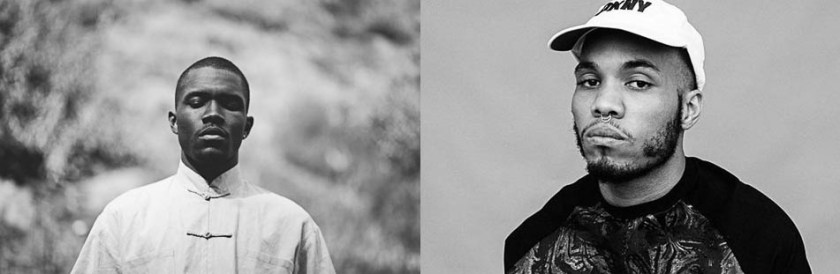
More creative use of the change-up can be found on songs where a story is being told from multiple characters or perspectives. Kendrick Lamar on “Sing about me” or Eminem on “Stan” saw those artists playing multiple characters on one track, but over the same beat. This narrative tool applies to R&B too, but Frank Ocean took it to another level on “Pyramids” which had two songs on one track and different styles for the different stories told; the first half a club track with a narrative about ancient Egypt and the concluding half taking the listener to the strip club.

So does it make sense on “Malibu” (an album that I compare to Ocean’s “Channel Orange” in terms of feel/mood)? I think you’d give a more favourable answer if you see .Paak as a singing rapper; on that argument, he’s just showing off what he can do. If you see him as a rapping singer, then it’s arguably less impressive as the change in styles on a track like “The Season/Carry Me”doesn’t add much to the listener’s experience (comparing it directly to Ocean’s effort).

However, the importance of this falls away if you place less emphasis on the concept of a “track”, which seems to be eroded more year on year. Look at Kanye West’s “The Life of Pablo”, or Kendrick Lamar’s new album/mixtape, “Untitled Unmastered” (the latter is admittedly a collection of demos and unmastered songs), where a “track” can include three different songs on it, for the current state of play in this regard. Ultimately, variation from the classic album and track formula makes for a more varied and exciting listen. Does an album or song become less cohesive as a result? This could be argued either way, depending on what you’re listening to.

New era. New site.

HeadphonesWe all get older, but our passions and what makes us tick never fades. How we express this matures and evolves.

The journey to this site started with a late night uni radio show of the same name. I was lucky enough to play the music that I loved to an unknown audience for an hour, with little to no knowledge of what people thought of the show or if I’d done enough to convince them to tune in the following week. I played Dilla for three songs straight, LA Beat scene for (essentially) a whole show and Tyler, the Creator’s “Yonkers” uncensored, pre-watershed. It was therapeutic, horribly self-indulgent and, as with most things, came to an end.

Having finished university, I started a “blog” that could be better described as a quasi-Twitter account. This blog looks to rectify its previous iteration’s missteps; it will focus solely on music related content and (at least try to) provide an element of critical input. If its predecessor was more your type of thing, I have now discovered Twitter for real, so feel free to follow me there too (@AJ_Eriksson).

Above all, this blog is my way of adding to the discussion of the wonderful world of music. As such, any comments you may have on anything you read here are welcome.

Thanks for reading (and listening).